Risk Radar reads psychosocial exposure from data your organisation already generates, rosters, timesheets, reports and events, corroborates it against what workers say, and benchmarks both against published Australian evidence. The result is a defensible, current read on safety and compliance, and clear direction on what to control now and what to build next.
Request a briefing How it worksPsychosocial risk now carries a legal duty in every Australian jurisdiction, and the codes no longer say the same thing in each one. Risk Radar is built for the people who have to answer for that.
A living hazard register aligned to the code that applies at each site, with evidence trails, honest coverage statements, and artefacts ready for your safety system, your board, or an inspector.
Exposure moves weekly. Annual reporting cycles cannot see it. Risk Radar surfaces combinations of hazards as they form, before they become injuries, claims, or prosecutions.
For coaching, training and wellbeing providers: a grounded read of each client environment, so the right intervention lands at the right tier, at the right time, with a measurable rationale.
Four streams of evidence, fused by corroboration rather than averaging. Most of the data already exists inside your systems, and workers are asked for seconds of their time, not surveys every week.
Rostering, timesheet and case metadata become daily exposure indicators, mapped to the psychosocial hazards named in your jurisdiction's code. Nobody is surveyed, tracked or scored. No content, no keystrokes, no location.
A single validated style check in, with optional attribution, converts worker experience into the same hazard language as the operational data. Voluntary, pseudonymous, and reported only in aggregate.
Internationally validated survey instruments run at the frequency they were designed for, benchmarked against published Australian working population data, not international averages or vendor norms.
Structural recommendations address the design of work over months. Adaptive recommendations give supervisors context for the work design decisions they already make daily. Both target the work, in line with the control hierarchy that regulators now expect. Enhancement is recommended only once an environment is stable, never into an unmanaged hazard, and workers are consulted before any control is decided.
Each site is assessed against the hazards named in the code that applies to it, and each hazard shows which independent sources agree. The monthly report is written to sit in a safety management system, not in a slide pack.
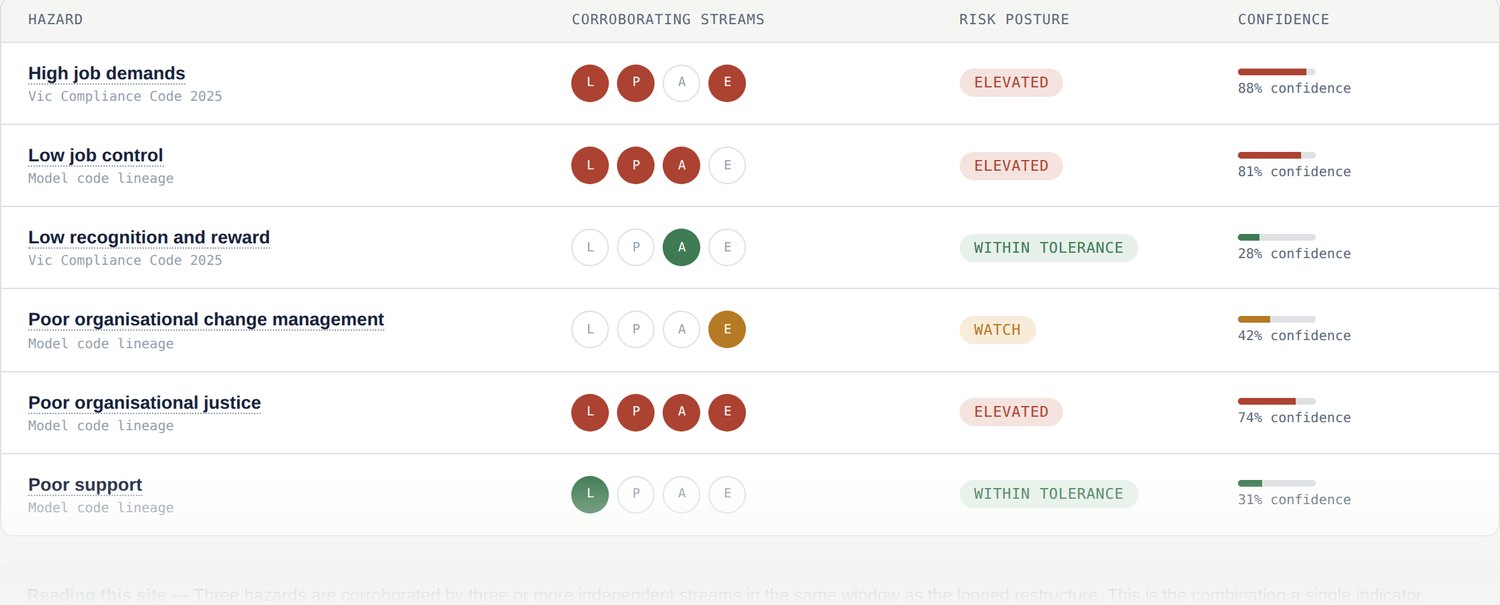
Risk level comes from the direction of the signals. Confidence comes from how many independent sources agree, so a single noisy input cannot drive a conclusion on its own.
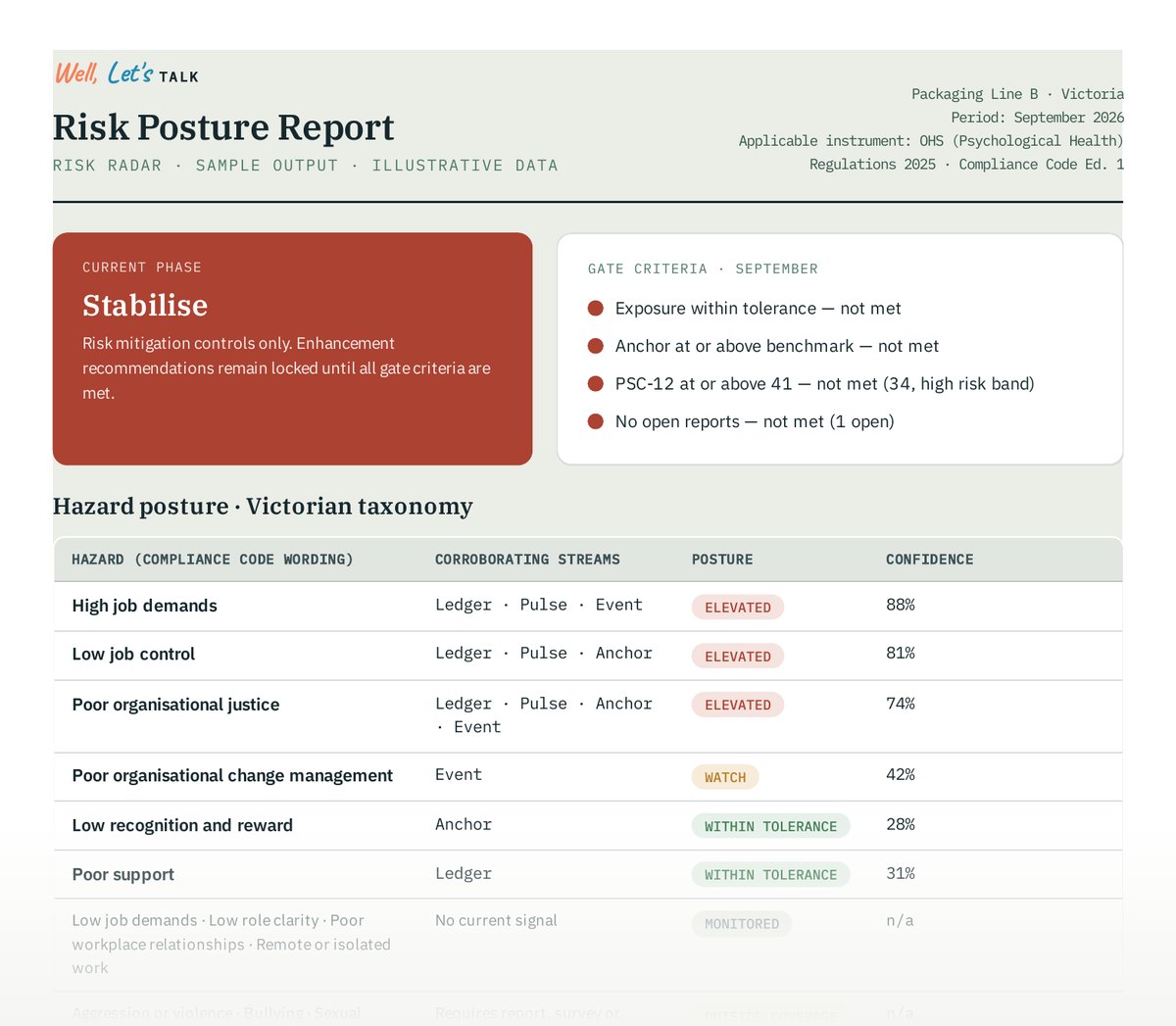
Phase, gate criteria, hazard posture and coverage, mapped to the applicable instrument.
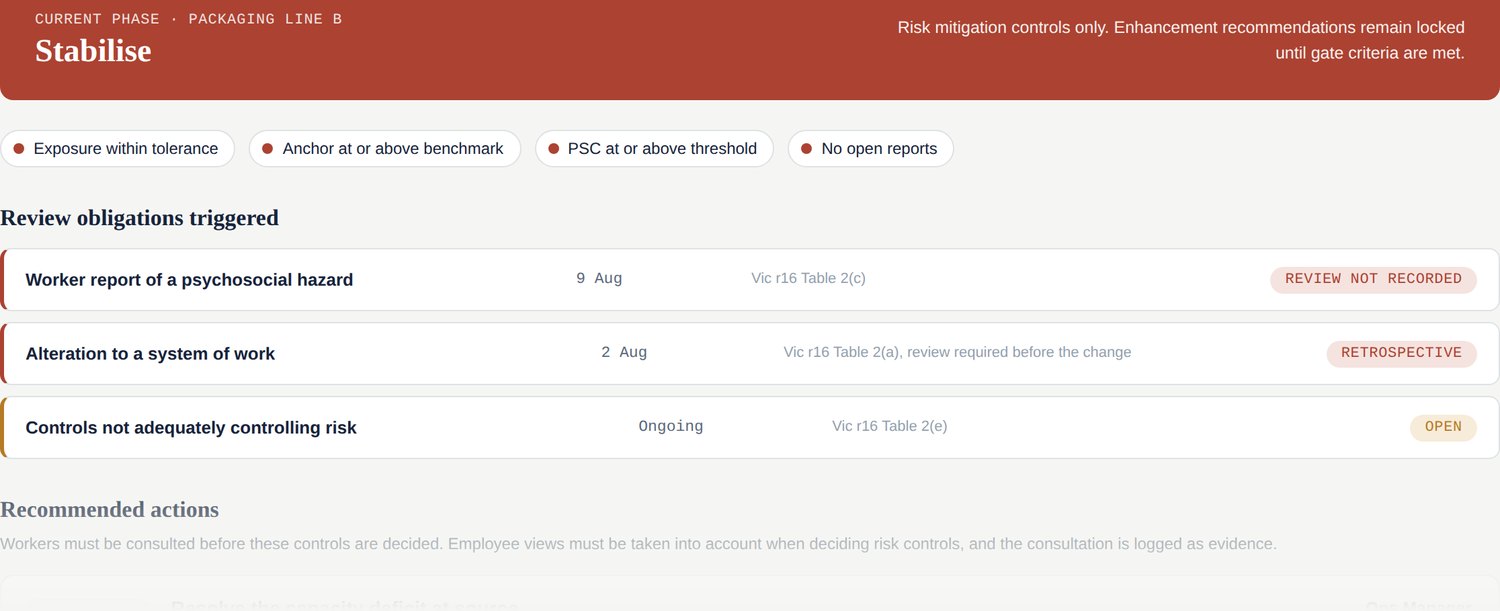
Every recommendation carries its position in the control hierarchy, the evidence behind it, and an owner. Enhancement stays locked until the environment is stable.
Illustrative data throughout. Calibration thresholds and decision logic are not shown.
No invented scores, no proprietary wellbeing index, no claims the science cannot carry. Every benchmark traces to a published source, and the tool says plainly what it can and cannot see.
Risk Radar is not a wellbeing app with a compliance sticker. It is a risk instrument, built by someone who has spent more than twenty years designing and delivering governance, risk and safety systems for some of the most safety conscious organisations in the world, across mining, energy, rail and logistics.
That practitioner grounding is paired with a Master of Applied Positive Psychology from the University of Melbourne, which is what shapes the second half of the tool: knowing not just how to make work safe, but what to build once it is.
The approach is set out publicly in the four part series Rethinking Psychosocial Risk, available on the main site.
A working demonstration exists and is shown under confidentiality to organisations and partners evaluating a pilot. Briefings cover the measurement architecture, the evidence base, the governance safeguards, and what a low friction pilot looks like using data you already hold.
Request a briefing Download the overviewRisk Radar is in staged development with pilot partners. Access to the working demonstration is by invitation and under confidentiality.